Comparison for small teams: Otterly vs Peec AI vs Doory
Otterly, Peec AI and Doory overlap a lot on features. What sets them apart is who each one is built for, and how much time it expects you to spend learning it before you can act.
Why AI Visibility Tools Exist
Maybe a customer has already told you they found you through ChatGPT. The next question is how often that happens, and which questions you show up for.
Otterly, Peec AI and Doory are three tools built to answer this. Here we explore some of the differences and which might be the best choice for you.
What Otterly, Peec AI and Doory have in common
On features, the three tools overlap more than they differ. Each one puts a set of questions to AI services on a schedule and records which businesses get named in the answers.
Each also shows which websites the answers drew on and suggests what to do about the gaps. So the choice comes down to who the tool is built for, and how much time it expects you to spend in it before you can act.
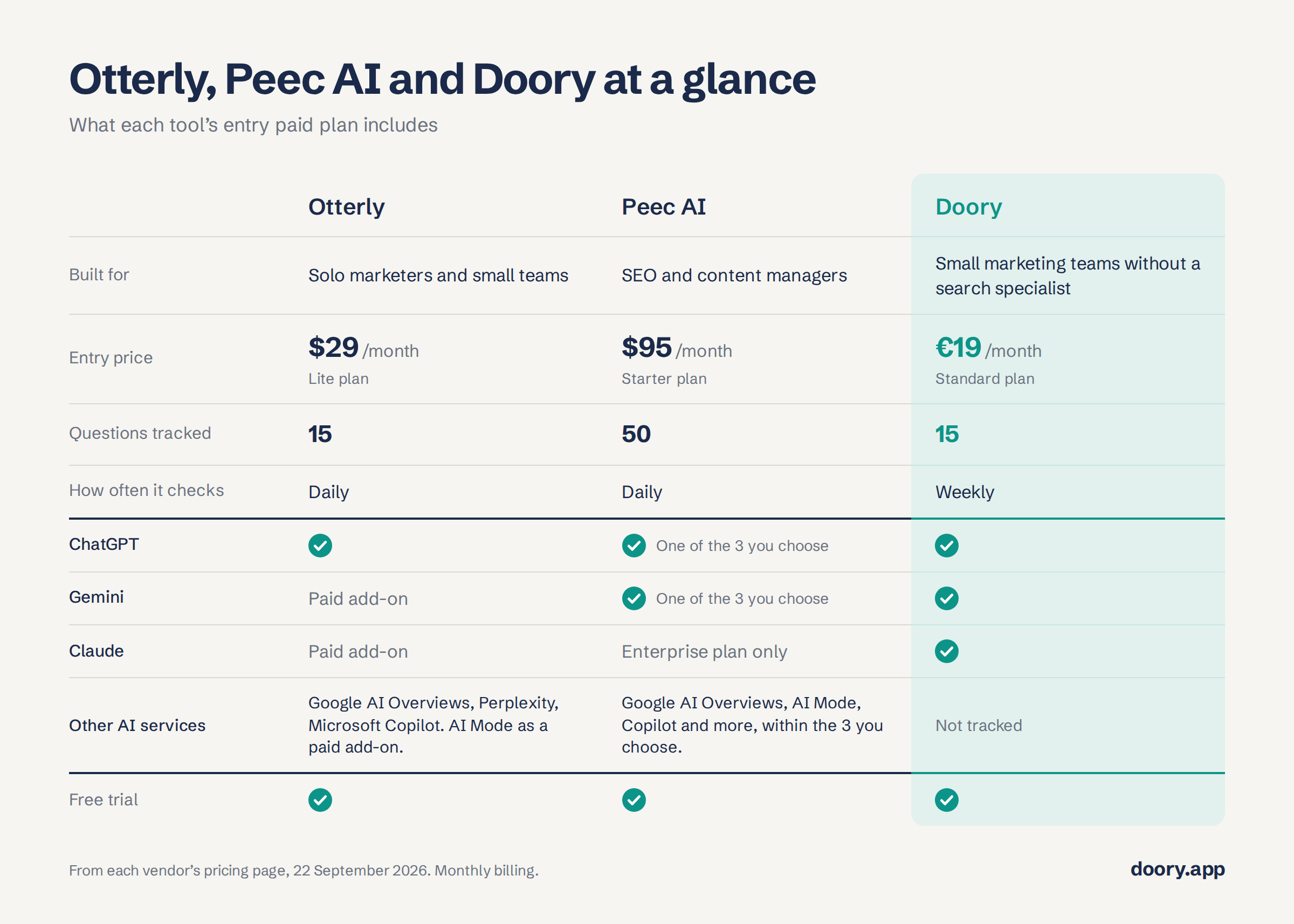
Here's how Otterly, Peec AI and Doory compare
These are the entry plans. All these providers have larger plans with more questions and more features.
Doory asks: are you mentioned, and what can you do about it?
Doory is built around two questions: do AI models mention you, and what can you do about it?
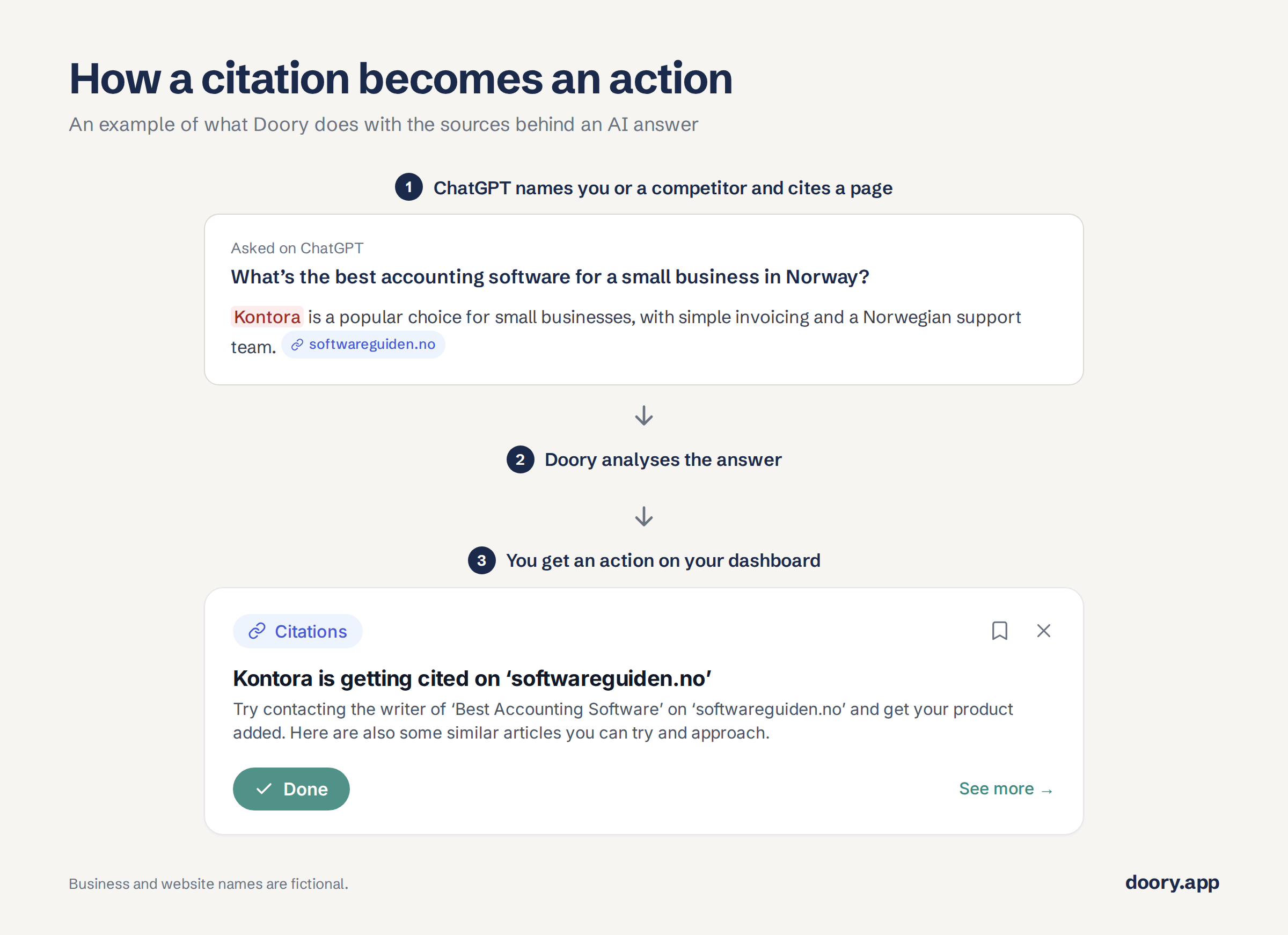
After your first scan you see the AI's answers word for word, with your name and your competitors' names highlighted. Alongside them you get actions based on what the scan found, such as getting listed on a directory the AI keeps citing when it recommends your competitors.
There no score, Doory simply tells you if you were mentioned or if a competitor was, what was written and why, and then what you can do to improve the answer in your favour.
Otterly and Peec AI give you more to measure. Otterly has a Brand Visibility Index, domain rankings, citation analysis and a GEO audit for your pages. Peec AI tracks visibility, position, sentiment and share of voice every day, and offers tools for fan-out analysis and crawler data.
If search is your job, that depth is worth having. If you're one of two marketers at a 40-person company and AI search is one item on a long list, learning a new field and its vocabulary can eat days before you know what to do on Monday. Doory is built for that second person.
Progress you can control, and the part that takes time
Doory counts progress in the work you can do yourself, such as getting listed on the sites AI cites when it answers questions about your field.
Whether ChatGPT then starts naming you is the slow part. It can take weeks after the work is done, and sometimes nothing moves. Doory tracks both, and it won't tell you that a particular listing caused a particular mention, because there are too many other factors to know that for sure (no other tools can claim this either so be wary if they do).
Questions in the languages your buyers use
In Doory you choose the language of each question, and one account can mix several.
A company in Oslo that sells in Norway and abroad might track the same buyer questions in Norwegian and in English. Doory shows which ones you're named in and flags it when you show up in one language but not the other. You can include the region you sell in too, whether that's Trøndelag or the West Midlands.
Does it matter whether a tool checks daily or weekly?
Daily checks give you more data points, but AI answers vary so much from one run to the next that real changes only become clear over weeks.
Ask ChatGPT the same question twice and you'll often get two different lists of businesses. In a study by SparkToro and Gumshoe, volunteers ran the same 12 prompts through ChatGPT, Claude and Google's AI nearly 3,000 times. The same list of brands came back less than once in a hundred runs, and the same list in the same order closer to once in a thousand.
The study also found that how often a brand appears across many runs is much steadier. That share is the number worth watching, and it takes a lot of answers over time to see it clearly. A drop on Tuesday followed by a jump on Thursday is often just the answers shuffling.
Daily tracking does collect more answers, and more answers help an average settle sooner. The changes you're working toward move slower than that, though. If you get listed on a site ChatGPT cites, any effect on how often it names you will take weeks or months to show, if it shows at all, and a weekly scan across all your questions and AI services is enough to follow that without reacting to swings that mean nothing.
Doory scans every day for the first couple of days after you sign up, so your first actions rest on more than a single run. After that it scans weekly, or every two days on Pro, and you can run a scan yourself when you've changed something and want a fresh look.
Price and AI services
Doory's paid plans start at €19 a month for 15 questions. Otterly's Lite plan is $29 a month for 15, and Peec AI's Starter plan is $95 a month for 50. All three offer a free trial, and Doory's trial covers ChatGPT and Gemini.
Doory includes Claude on its paid plans. Otterly sells Claude as an add-on from $29 a month and Peec AI lists it on Enterprise only, according to Otterly's pricing page and Peec AI's pricing page. Doory doesn't cover Perplexity, Google AI Overviews or Copilot currently.
Which one fits your team?
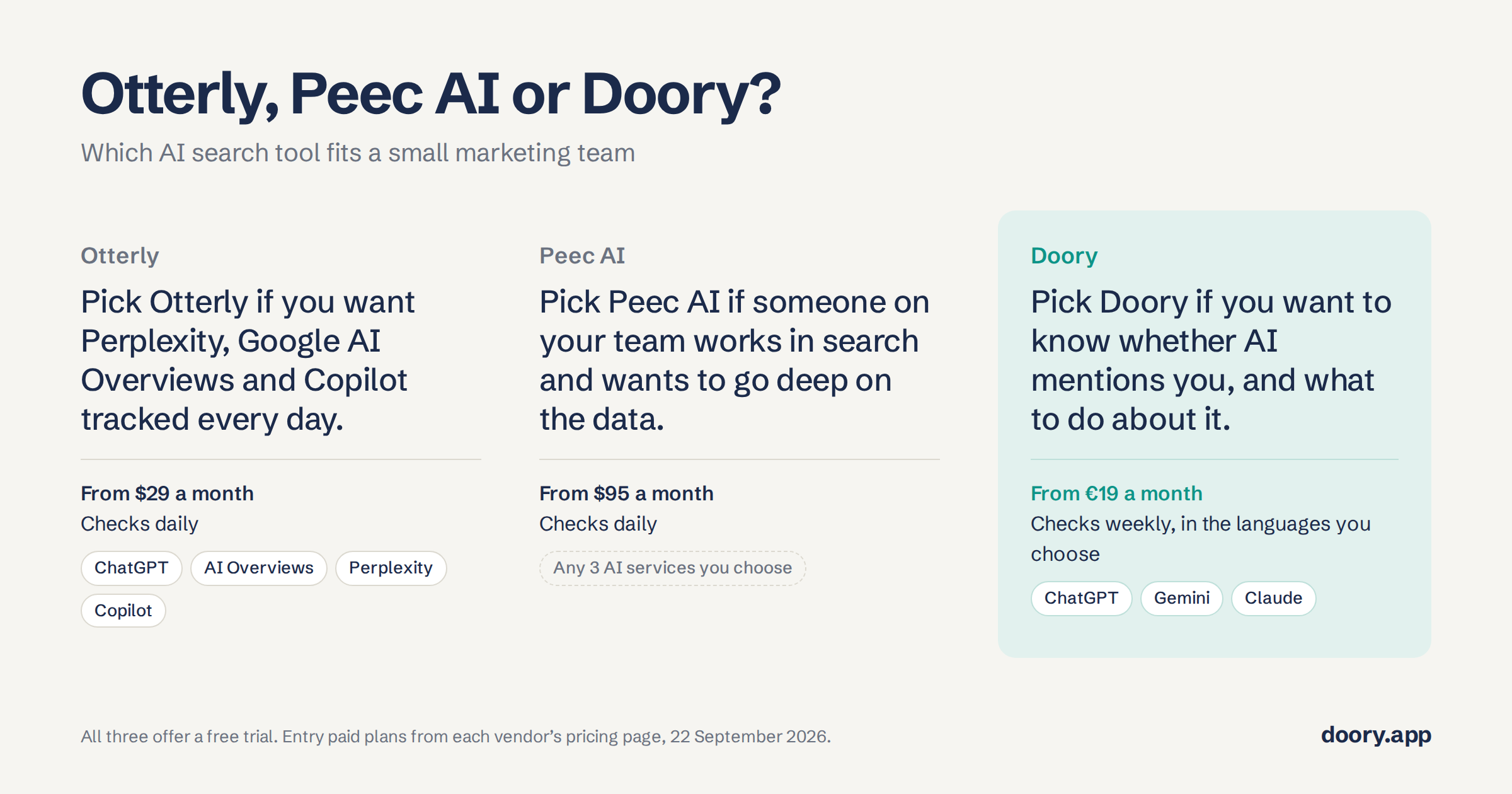
Otterly is a good fit if you want ChatGPT, Perplexity, Google AI Overviews and Copilot tracked every day, plus audits of your own web pages. Like Peec AI, it includes unlimited team members, and it has a programme for agencies running several clients.
Peec AI suits a company with someone who works in search and will spend real time in the data each week. It tracks more questions per plan and goes further on reporting.
Doory is for the small marketing team, often one to three people answering to a founder, who have seen AI send them a customer and want to act on it without learning a new discipline first. It currently has one login per account today, which is worth knowing if several people need access.
What you can control, and where Doory fits
You can't decide what ChatGPT, Gemini or Claude say about you. You can decide where you show up: the directories and review sites they read, and how clearly your own website explains what you do and who it's for.
Some of your customers may already be finding you through ChatGPT. Doory shows you what it says about you and gives you actions based on what it finds, so the AI has more reasons to recommend you. You can start with a free trial and read your first AI answers a few minutes after signing up.